By Dr. Stephanie Diana Eubank DBA
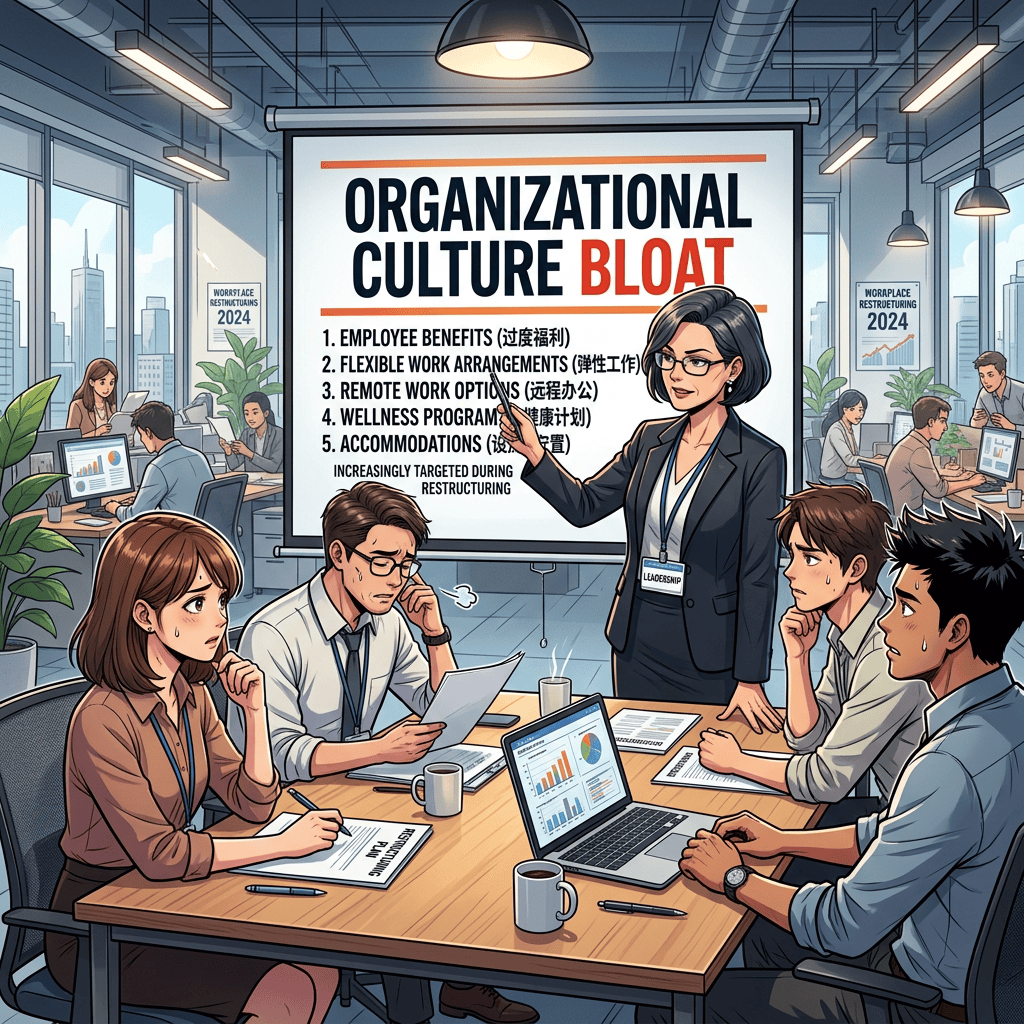
A new phrase has begun appearing in workplace discussions: organizational culture bloat. The term is often used to describe employee benefits, flexible work arrangements, remote work options, wellness programs, and other workplace accommodations that some leaders now view as excessive. Increasingly, these benefits are being targeted during organizational restructuring efforts.
While organizations certainly have the right to evaluate costs and operational effectiveness, the framing of employee flexibility as a form of cultural excess deserves closer examination. Many organizations spent years promoting remote work, flexible schedules, and employee-centered policies as strategic advantages for recruitment and retention. Now, some organizations are attempting to reverse course by describing these same benefits as barriers to efficiency or examples of organizational excess.
One concern raised by employees is that return-to-office mandates may function as an indirect workforce reduction strategy. Rather than conducting formal layoffs, organizations may implement policies that encourage voluntary departures from employees who cannot accommodate commuting requirements, caregiving responsibilities, disability accommodations, or geographic constraints.
Available workforce data suggest that flexibility remains an important workplace consideration. According to the U.S. Bureau of Labor Statistics, 57% of workers reported having flexible schedules during 2024–2025. Additionally, 34% of wage and salary workers worked from home at least occasionally, while 28% had days where they worked exclusively from home. These numbers suggest that workplace flexibility has become a significant component of modern employment rather than a temporary trend.
The productivity debate surrounding remote work is often more complex than organizational rhetoric suggests. Research published by the Bureau of Labor Statistics found a positive relationship between increases in remote work and total factor productivity growth. The research reported that a one-percentage-point increase in remote workers was associated with approximately a 0.08 percentage-point increase in productivity growth.
When leaders describe flexibility as culture bloat, they may overlook a fundamental principle of organizational behavior: people are often more committed to organizations when they feel trusted, respected, and psychologically safe. Decades of management and organizational research suggest that employee engagement, innovation, and commitment are strongly influenced by leadership practices rather than physical work location alone.
This phenomenon is especially relevant when examining highly authoritarian or micromanagement-oriented leadership styles. Such approaches are often associated with reduced autonomy, lower employee satisfaction, diminished creativity, and increased turnover intentions. Employees who feel constantly monitored frequently become less willing to take risks, share ideas, or engage in creative problem solving.
Conversely, employees who experience trust, autonomy, and job security are often more willing to contribute innovative ideas and discretionary effort. Gallup research has found that fully remote employees reported higher engagement levels than several other work arrangements, suggesting that flexibility and autonomy may contribute positively to employee commitment and performance.
The broader issue may not be organizational culture bloat but rather a misunderstanding of the symbiotic relationship between workers and organizations. Healthy organizations create value by aligning organizational goals with employee needs. Economic sociology, organizational behavior research, and human resource management literature consistently demonstrate that employee well-being and organizational performance are interconnected.
Organizations should be careful not to confuse employee-centered policies with inefficiency. Leaders must evaluate whether eliminating benefits solves operational challenges or simply reduces organizational attractiveness in an increasingly competitive labor market. In many industries, the organizations that retain top talent are those that create environments where employees feel valued, respected, and empowered to contribute.
The future of work is unlikely to be defined by a simple choice between remote and in-person work. Instead, successful organizations will focus on creating cultures built on trust, accountability, flexibility, and measurable outcomes. The organizations that thrive will be those that understand that employee well-being and organizational performance are not competing priorities. They are mutually reinforcing goals.
Book Spotlight
Remote Work Is Here to Stay: Rethinking Operations Management in the Modern Work Era
Available on Amazon: https://www.amazon.com/dp/B0H5BPJCHJ
As businesses continue adapting to changing work environments, operational excellence and effective remote leadership remain critical skills for success.
Thank you for reading. If you enjoy this content, like and subscribe. If you are interested in consulting services, please feel free to connect with me through my social media channels.
Remember: Remote is here to stay.
Website: wickedbofthewestconsulting.com
YouTube: https://www.youtube.com/@Wickedbofthewest
Facebook: https://www.facebook.com/WickedBoftheWestBusinessConsulting
Instagram: https://www.instagram.com/wickedbofthewestconsulting/
LinkedIn: https://www.linkedin.com/in/stephanie-diana-eubank-dba/
Company LinkedIn: https://www.linkedin.com/company/wicked-b-of-the-west-business-consulting
TikTok: @drstephanieeubank
Blog: drstephaniebeardbaremoteresearch.org
Email: wickedbofthewestconsulting@gmail.com
References
Gallup. (2025). The remote work paradox: Higher engagement, lower wellbeing.
U.S. Bureau of Labor Statistics. (2026). Job flexibilities and work schedules summary.
U.S. Bureau of Labor Statistics. (2025). Productivity and remote work.
🚀 Still managing a 2026 workforce with 2016 solutions?
The future of work is here, and your business needs processes, leadership strategies, and systems designed for today’s realities.
At Wicked B of the West Business Consulting, we help organizations:
✔ Build successful remote and hybrid workplaces
✔ Improve operations and business processes
✔ Develop effective leaders and teams
✔ Implement AI and productivity tools responsibly
✔ Design scalable systems for growth
✔ Create accessible workplaces that work for everyone
Whether you’re a startup, small business, nonprofit, or educational institution, we’ll help you work smarter, not harder.
📚 Author. Researcher. Consultant.
🌐 http://www.wickedbofthewestconsulting.com


Leave a Reply