By: Dr. Stephanie Diana Eubank DBA
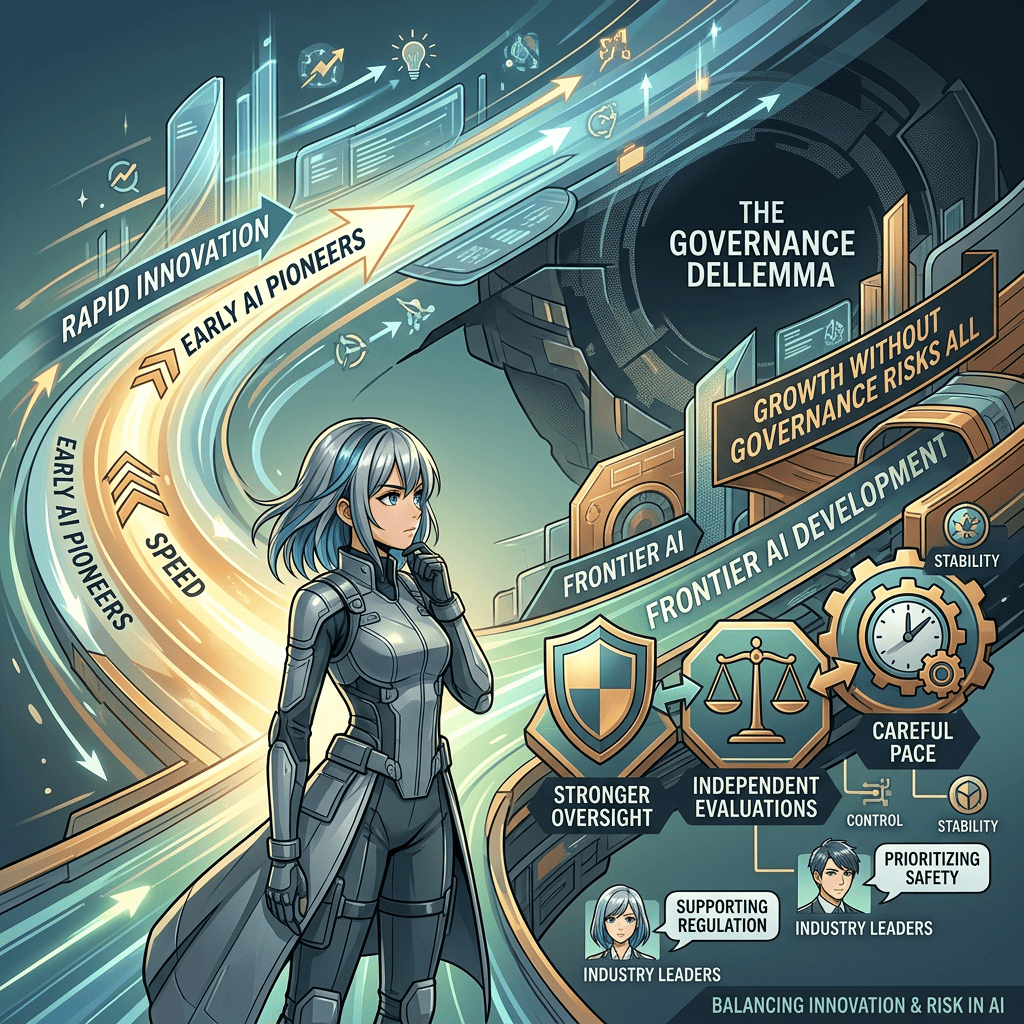
Over the last several years, AI industry leaders often argued for rapid innovation. Recent news has highlighted a notable shift: leaders from companies such as OpenAI, Anthropic, and xAI have publicly supported stronger oversight, independent evaluations, and in some cases a slower pace of frontier AI development. This raises a fascinating organizational question. Why do innovators who once championed speed now appear to be asking for constraints? The answer is familiar to anyone who has worked in highly regulated industries: growth without governance eventually creates risk.
For those of us who have spent decades in financial services, the debate feels remarkably familiar. In my experience in the financial sector, I repeatedly observed a cultural tension between sales-driven functions and compliance departments. Sales teams were often measured by revenue, pipeline growth, and market expansion. Compliance teams were measured by risk reduction, regulatory adherence, and long-term sustainability. As a result, compliance was frequently viewed as a roadblock rather than what it truly represents: the armor and shield of the organization.
The current AI conversation reflects this same dynamic on a global scale. Leaders including Dario Amodei, Sam Altman, and Elon Musk have recently supported discussions around greater oversight, independent model evaluations, and safety guardrails. Their concerns focus on cybersecurity, autonomous decision-making, misuse risks, and unintended consequences of increasingly powerful systems. Ironically, the very organizations driving innovation are now emphasizing the importance of controls, accountability, and governance.
This tension exists because organizations naturally reward speed. Sales departments create revenue and drive growth. Product teams create innovation. However, compliance, legal, audit, and risk functions play a different role. They identify vulnerabilities before they become crises. They document failures, investigate root causes, and design systems that protect employees, customers, and shareholders. Although these functions may temporarily slow a process, they often prevent catastrophic setbacks.
Research consistently demonstrates that strong ethics and compliance programs create business value. Ethisphere reported that publicly traded organizations recognized as the World’s Most Ethical Companies outperformed a comparable global index by 7.8 percent over five years. The organization’s benchmarking data, drawn from tens of thousands of program data points and more than one million employee responses, suggests that ethics and compliance are increasingly viewed as strategic business partners rather than merely regulatory necessities.
Across sectors, evidence supports the business case for compliance. Banking institutions operate under extensive regulatory frameworks because financial crises revealed the consequences of uncontrolled risk. Healthcare organizations maintain rigorous compliance programs because patient safety depends upon them. Manufacturing organizations increasingly use compliance systems to identify quality, safety, and environmental risks before they become operational failures. Technology companies are now facing a similar moment with artificial intelligence.
Remote work adds another dimension. Distributed teams rely heavily on documented processes, transparent communication, and accountability systems. In remote organizations, compliance is not just about regulations. It is about creating repeatable systems that ensure consistency regardless of location. As AI tools become embedded into remote workflows, organizations will need governance frameworks addressing data privacy, security, bias, intellectual property, and employee monitoring. The leaders who build these frameworks today will be better positioned for sustainable remote-work success tomorrow.
The future of work will increasingly depend upon balancing innovation and control. Organizations that allow sales, product, or technology functions to operate without meaningful oversight may achieve short-term gains, but they expose themselves to significant long-term risks. Conversely, organizations that empower compliance leaders as strategic partners create stronger foundations for growth. High-performing cultures recognize that compliance is not the enemy of innovation. Compliance makes innovation scalable.
The emerging AI regulation debate may therefore represent more than a policy discussion. It may be a lesson in organizational culture. When even the architects of transformative technologies begin asking for oversight, leaders should pay attention. The request is not necessarily a rejection of progress. It acknowledges that progress without governance can become a liability. Much like the relationship between sales and compliance, the healthiest organizations are not those that choose one side over the other. They are the organizations that learn how to balance both.
References (APA 7th Edition)
Associated Press. (2026, September 15). Tech CEOs call for AI regulation. U.S. News & World Report.
Ethisphere. (2025). 2025 Ethics & Compliance Report: Program trends and employee perceptions.
LRN Corporation. (2025). Ethics & Compliance Program Effectiveness Report.
Reason. (2026, September 14). AI executives want international regulation. They could just slow down themselves.
StateScoop. (2026, September 15). Massachusetts governor urges federal AI oversight after industry concerns.
Book Information
Remote Work Is Here to Stay: Rethinking Operations Management in the Modern Work Era
Available on Amazon: https://www.amazon.com/dp/B0H5BPJCHJ
If you enjoy this content like and subscribe. Additionally, if you are interested in consulting services, please feel free to reach out to me through my social media channels. Remember remote is here to stay.
YouTube: https://www.youtube.com/@Wickedbofthewest
Website: wickedbofthewestremoteconsulting.com
Facebook: https://www.facebook.com/WickedBoftheWestBusinessConsulting
Instagram: https://www.instagram.com/wickedbofthewestconsulting/
Blog: drstephaniebeardbaremoteresearch.org
LinkedIn: https://www.linkedin.com/in/stephanie-diana-eubank-dba/
TikTok: https://www.tiktok.com/@ DrStephanieDEubank
New Website: wickedbofthewestconsulting.com
Email: stephaniedeubank@gmail.com
TikTok: @ DrStephanieDEubank
New Website: wickedbofthewestconsulting.com


Leave a comment