By: Dr. Stephanie Diana Eubank
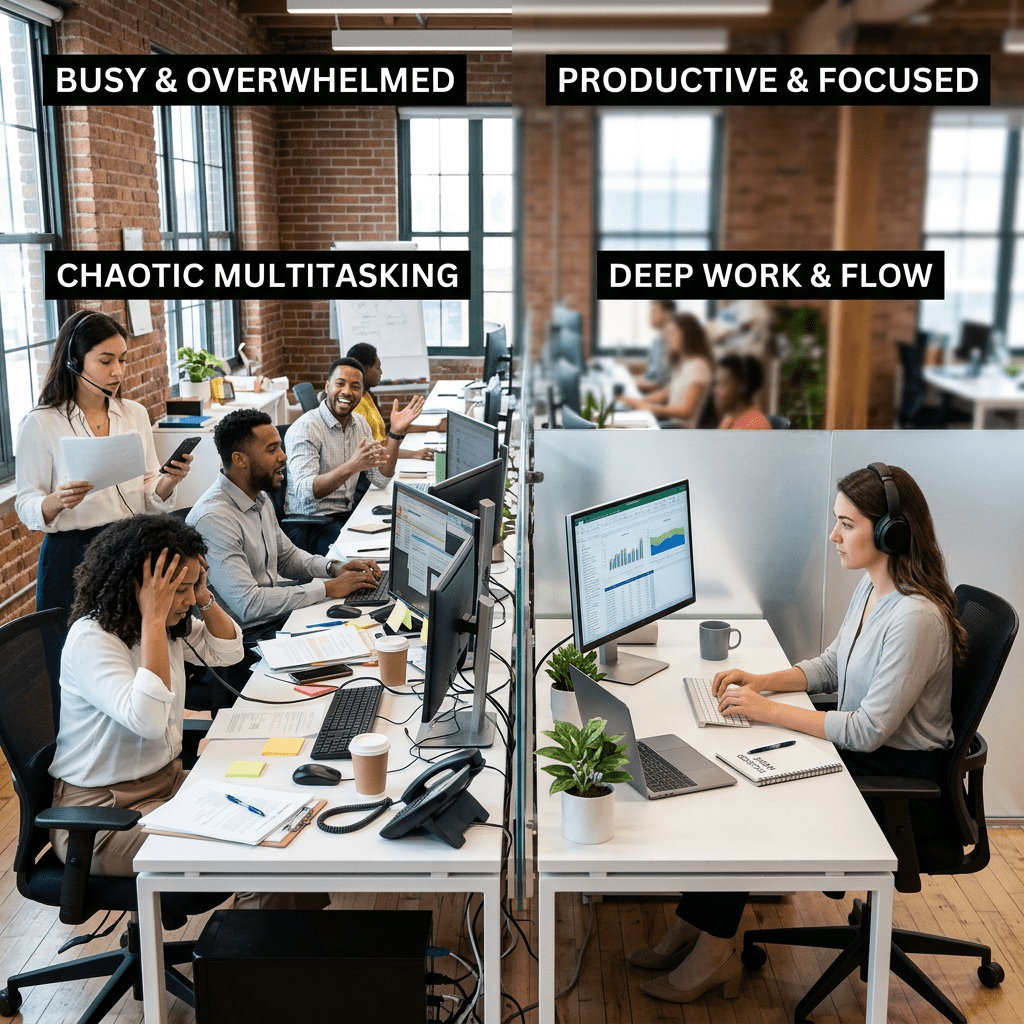
Across industries and leadership modalities (remote work, Hybrid, and in- person), a persistent myth continues to shape how employee performance is evaluated: if people look busy, they must be productive. Full calendars, constant emails, rapid task-switching, and visible exhaustion are often rewarded as commitment. However, decades of organizational psychology and neuroscience research demonstrate that busyness is not only a poor proxy for productivity it actively suppresses creative problem solving, innovation, and long-term performance.
https://youtu.be/wegRRn_KY8Q
How Leaders Confuse Busyness with Productivity
Many leaders equate observable activity with value because it is easy to measure. Time spent in meetings, responsiveness to messages, and long hours provide a sense of control and reassurance. However, research consistently shows that knowledge work productivity is outcomes-based, not activity-based. Excessive task switching and constant interruptions dramatically reduce cognitive performance and creative capacity (Levitin, 2014; Baror & Bar, 2016).
Stanford researcher Emma Seppälä explains that creativity relies on the brain’s default mode network activated during periods of rest, reflection, and unfocused thinking. Chronic busyness keeps the brain locked in executive-control mode, preventing insight, synthesis, and novel connections (Seppälä, as cited in Beres, 2017).
In leadership cultures that valorize urgency and constant availability, employees learn to perform busyness rather than pursue impact. The result is performative productivity: motion without meaning.
Why Busyness Kills Creative Problem Solving
Creative problem solving requires uninterrupted time, psychological safety, and cognitive space. Research from Bar-Ilan University found that individuals under high mental load produced statistically less original ideas than those with fewer cognitive demands (Baror & Bar, 2016). Similarly, multitasking and constant digital interruption reduce working memory and impair idea generation.
Additional research demonstrates that creativity improves when attentional demands decrease. Atchley, Strayer, and Atchley (2012) found a 50% improvement in creative problem-solving performance after sustained disconnection from technology. This has profound implications for modern workplaces structured around constant connectivity.
When organizations optimize for busyness meetings stacked back-to-back, rapid-response cultures, and excessive monitoring they eliminate the very conditions under which innovation thrives.
Why Remote Work Creates Conditions for Real Productivity
Remote work disrupts visibility-based management and forces leaders to evaluate outputs instead of activity. Large-scale studies from the U.S. Bureau of Labor Statistics (2024) and the Federal Reserve (Tito, 2025) show that remote and hybrid work arrangements are associated with stable or increased productivity, particularly in knowledge-based roles.
Remote work reduces commute-related cognitive depletion, allows employees to align work with peak cognitive hours, and minimizes unnecessary interruptions. These factors align directly with the conditions required for creative and strategic thinking.
Harvard Business School researchers found that business leaders’ perceptions of remote productivity shifted from negative to positive once outcomes not presence became the primary measure of performance (Bartik et al., 2025). When employees are trusted and given autonomy, discretionary effort and innovation increase.
From Control to Creativity: A Leadership Shift
The future of effective leadership requires a move from surveillance to stewardship. Leaders must stop asking whether employees look busy and start asking whether the work being done creates value. This requires:
• Measuring outcomes instead of hours
• Designing work for deep focus
• Protecting time for thinking, not just doing
• Normalizing rest as a productivity strategy
Remote and flexible work models are not perks; they are structural enablers of creativity, inclusion, and sustainable performance.
Conclusion
Busy-ness is a false idol of modern leadership. It reassures managers while quietly eroding innovation and employee well-being. In contrast, productivity rooted in focus, autonomy, and trust creates the cognitive space necessary for creative problem solving. Remote work, when intentionally designed, offers leaders the opportunity to finally align how work is measured with how value is actually created.
—
References
Atchley, R. A., Strayer, D. L., & Atchley, P. (2012). Creativity in the wild: Improving creative reasoning through immersion in natural settings. PLOS ONE, 7(12), e51474. https://doi.org/10.1371/journal.pone.0051474
Baror, S., & Bar, M. (2016). Associative activation and the dark side of creative cognition. Psychological Science.
Bartik, A., Cullen, Z., Glaeser, E. L., Luca, M., & Stanton, C. (2025). The rise of remote work: Evidence on productivity and preferences from firm and worker surveys. Journal of Economics & Management Strategy, 34(3), 759–772.
Beres, D. (2017). Being busy is killing our ability to think creatively. Big Think. https://bigthink.com/neuropsych/creativity-and-distraction/
Pabilonia, S. W., & Redmond, J. J. (2024). The rise in remote work since the pandemic and its impact on productivity. U.S. Bureau of Labor Statistics. https://www.bls.gov/opub/btn/volume-13/remote-work-productivity.htm
Tito, M. D. (2025). Decoding the productivity puzzle: A new perspective on the relationship between remote work and productivity. Federal Reserve Board.
If you enjoy this content like and subscribe. Additionally, if you are interested in consulting services, please feel free to reach out to me through my social media channels. Remember remote is here to stay.
YouTube: https://www.youtube.com/@Wickedbofthewest
Website: wickedbofthewestremoteconsulting.com
Facebook: https://www.facebook.com/WickedBoftheWestBusinessConsulting
Instagram: https://www.instagram.com/wickedbofthewestconsulting/
Blog: drstephaniebeardbaremoteresearch.org
LinkedIn: https://www.linkedin.com/in/stephanie-diana-eubank-dba/
TikTok: https://www.tiktok.com/@stephanie.eubank6
New Website: wickedbofthewestconsulting.com
Email: Drstephaniedeubank@wickedbofthewestconsulting.com or stephaniedeubank@gmail.com
TikTok: @stephaniedianaeubank
New Website: wickedbofthewestconsulting.comtconsulting.com


Leave a Reply