By: Dr. Stephanie Diana Eubank DBA
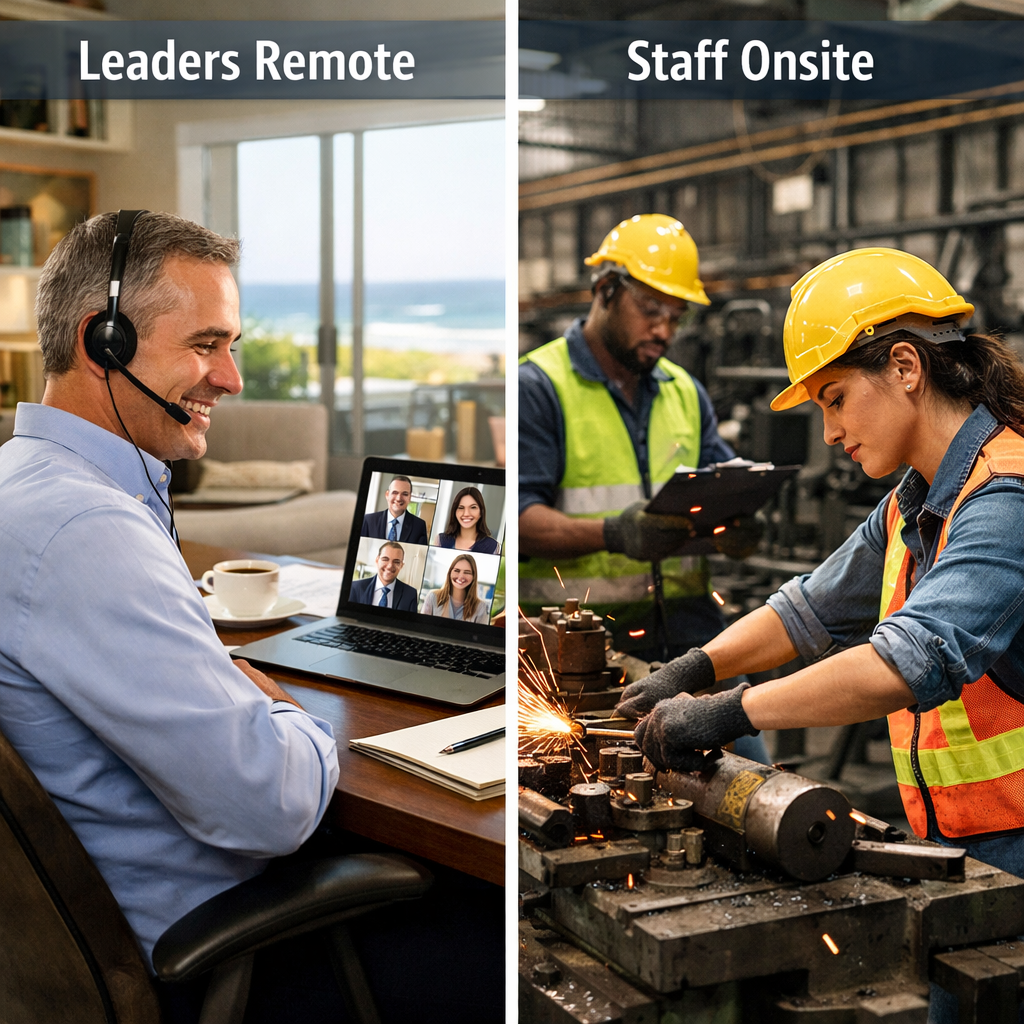
Remote and hybrid work have become defining features of modern organizations, yet access to flexible work remains unevenly distributed. Across many industries, remote work is disproportionately offered to leaders and subject matter experts (SMEs), while employees in non‑management roles despite performing work equally compatible with remote delivery are often required to remain on‑site. This pattern reflects a structural imbalance rather than operational necessity and has implications for organizational trust, productivity, and cohesion.
Research following the COVID‑19 pandemic indicates that senior leaders are more likely to retain remote or hybrid flexibility while return‑to‑office mandates are enforced for individual contributors. This dynamic effectively transforms remote work into a leadership privilege rather than a modality aligned to job design. Studies show that leaders are commonly hired and retained remotely, while followership roles experience reduced autonomy even when performance outcomes do not require physical presence.
A critical tension arises when leaders themselves are not consistently on‑site while requiring their teams to be physically present. Evidence from engagement research shows that employees who could work remotely but are required to attend in person report the lowest levels of engagement across all work arrangements. This disconnect reinforces power distance, signals mistrust, and erodes the legitimacy of leadership expectations.
From a structural perspective, this represents a missed opportunity. Research on hybrid and remote work consistently demonstrates that productivity is driven by clarity, equitable access to flexibility, and intentional team design not proximity. Extending remote work across all roles that do not require physical presence improves alignment between leaders and followers, reduces turnover, and strengthens accountability through shared systems.
The inequitable distribution of remote work also contributes to socio‑economic disparities. Employees in non‑leadership roles are more likely to bear commuting costs, childcare constraints, and geographic immobility. Expanding remote work opportunities for these roles alleviates financial pressure, improves retention, and enables organizations to better utilize their existing talent without increasing labor costs.
Remote work should be understood as a structural design choice rather than a hierarchical reward. Organizations that align flexibility to role requirements instead of rank create stronger cohesion, reduce power distance, and increase engagement across levels. Evidence from leadership and followership research suggests that congruence in working conditions strengthens trust and improves performance outcomes.
Ultimately, organizations that reserve remote work for leadership alone risk entrenching division within their workforce. Those that apply remote work equitably based on the nature of work rather than organizational status are better positioned to foster trust, productivity, and long‑term organizational resilience.
References
Ashkenas, R. (2025). The pandemic proved that remote leadership works. Harvard Business Review. https://hbr.org/2025/03/the-pandemic-proved-that-remote-leadership-works
Bloom, N. (2024). Hybrid work is a win‑win‑win for companies and employees. Stanford News. https://news.stanford.edu/stories/2024/06/hybrid-work-is-a-win-win-win-for-companies-workers
Bloom, N., Liang, J., Roberts, J., & Ying, Z. J. (2013). Does working from home work? Evidence from a Chinese experiment. Stanford Graduate School of Business. https://www.gsb.stanford.edu/faculty-research/working-papers/does-working-home-work-evidence-chinese-experiment
Global Workplace Analytics. (2026). Hybrid work costs and benefits. https://globalworkplaceanalytics.com/resources/costs-benefits
Pabilonia, S. W., & Redmond, J. J. (2024). The rise in remote work since the pandemic and its impact on productivity. U.S. Bureau of Labor Statistics. https://www.bls.gov/opub/btn/volume-13/remote-work-productivity.htm
Zhang, G., Zhao, W., & Meng, J. (2025). The impact of leader–follower power distance congruence on employees’ job role performance in the digital workplace. Digital Economy and Sustainable Development, 3(22). https://doi.org/10.1007/s44265-025-00073-6
If you enjoy this content like and subscribe. Additionally, if you are interested in consulting services, please feel free to reach out to me through my social media channels. Remember remote is here to stay.
YouTube: https://www.youtube.com/@Wickedbofthewest
Website: wickedbofthewestremoteconsulting.com
Facebook: https://www.facebook.com/WickedBoftheWestBusinessConsulting
Instagram: https://www.instagram.com/wickedbofthewestconsulting/
Blog: drstephaniebeardbaremoteresearch.org
LinkedIn: https://www.linkedin.com/in/stephanie-diana-eubank-dba/
TikTok: https://www.tiktok.com/@stephanie.eubank6
New Website: wickedbofthewestconsulting.com
Email: Drstephaniedeubank@wickedbofthewestconsulting.com or stephaniedeubank@gmail.com
TikTok: @stephaniedianaeubank
New Website: wickedbofthewestconsulting.comtconsulting.com
 Wicked B of the West Business Consulting
Leave a comment